
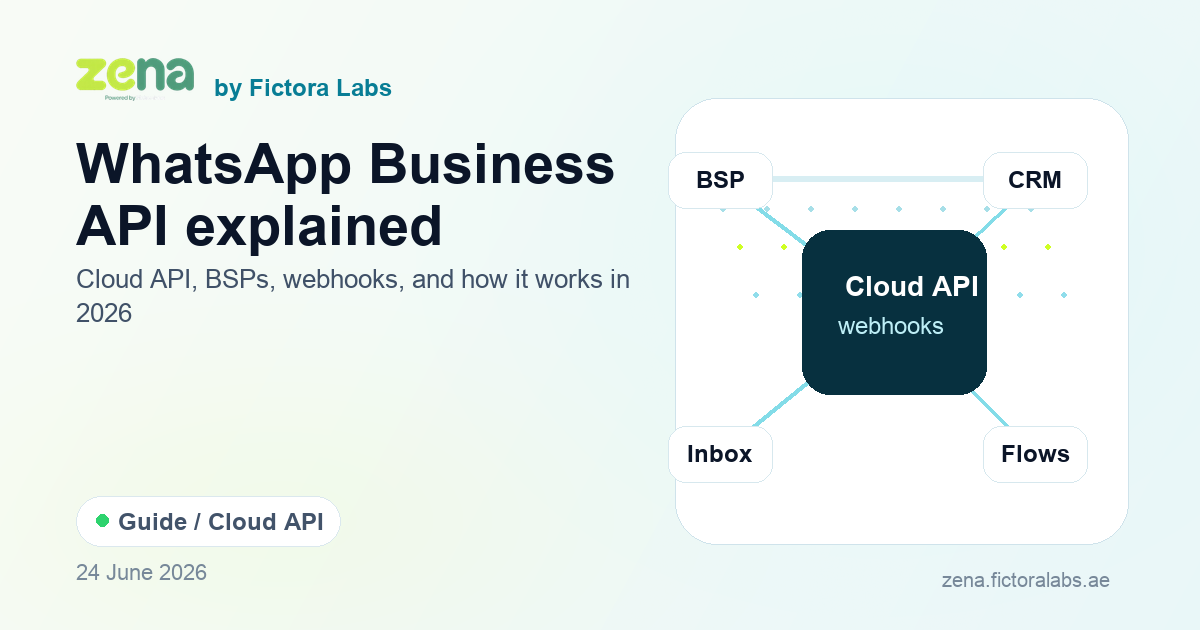
The WhatsApp Business API is Meta's Cloud API, the official way to send and receive WhatsApp messages through software instead of the phone app. The API gives developers messaging endpoints and webhooks; a BSP or Solution Partner adds the usable business layer: inbox, routing, automation, billing, support, CRM sync, and analytics. That distinction matters because most buyers are not only asking "what is the API?" They are asking which provider can turn the API into a working customer communication system.
If you searched for this, here is the short answer
- What is a WhatsApp BSP? A BSP, now commonly called a Solution Partner, is the provider that packages Meta's Cloud API with billing, onboarding, support, inboxes, routing, automation, and integrations.
- What does the Cloud API do? It sends outbound messages through Meta's Graph API and receives inbound customer messages through webhooks. It does not include a team inbox, CRM, chatbot builder, or analytics dashboard by itself.
- Which provider should I choose? Choose based on the platform layer, not only API access: shared inbox quality, routing, Arabic support, CRM/webhooks, billing currency, data residency, and support responsiveness.
- Can the API handle branches, bookings, and support queues? Yes, but that logic is built by the BSP platform on top of webhooks, assignment rules, CRM fields, and automation workflows.
What Meta Actually Calls This: The Product Naming Explained
The naming structure has three layers, and each refers to something distinct:
- WhatsApp Business Platform is the umbrella product name for the entire enterprise-grade offering. This is what Meta uses in developer documentation and partner materials when referring to the product family.
- Cloud API (hosted by Meta) is the specific API product. When someone says "WhatsApp Business API," they almost always mean the Cloud API. It launched in May 2022 and is now the only API path Meta supports.
- On-Premises API was the previous API path, where businesses hosted the WhatsApp messaging stack on their own servers. It is gone: Meta announced its deprecation on October 27, 2023, stopped new sign-ups on July 1, 2024, and the final supported version expired on October 23, 2025. The On-Premises API cannot be used to send messages. Any business evaluating WhatsApp API solutions in 2026 has only one option: the Cloud API.
Vendors and BSPs use various commercial names: "WhatsApp Business API," "WhatsApp Cloud API," "WhatsApp API platform." All refer to the same underlying Meta product. Meta's developer documentation consistently uses "WhatsApp Business Platform" as the umbrella name and "Cloud API" for the API itself.
What Meta calls third-party providers is also worth noting. The official term is Solution Partners (also referred to informally as Business Solution Providers or BSPs). Meta's definition: "Solution Partners are Meta Business Partners that provide a full range of WhatsApp Business Platform services to other businesses, such as messaging services, billing, integration support, and customer support."
What the Cloud API Actually Does
The Cloud API is hosted entirely by Meta. Unlike the On-Premises API, businesses do not need to provision or maintain any server infrastructure. Everything runs on Meta's infrastructure; you interact with it via HTTP requests.
How messages flow
The Cloud API operates on a two-direction model:
- Outbound messages: Your application (or BSP platform) sends HTTP POST requests to Meta's Graph API endpoints to deliver messages to WhatsApp users. Meta handles delivery.
- Inbound messages: When a user sends your business a message, Meta pushes a webhook payload to a URL you register. Your application or BSP platform receives the event, parses it, and responds accordingly.
Webhook payloads are signed by Meta using HMAC-SHA256. You verify the signature against your application secret to confirm the payload came from Meta and has not been modified in transit. This is required for production deployments. Do not process webhook payloads without verifying the signature.
What you can send via the Cloud API
- Text messages
- Media messages: images, audio, video, documents, stickers
- Interactive messages: reply buttons (up to 3 options), list messages (up to 10 rows), product messages, and flows
- Template messages: pre-approved message formats required for outbound messages outside an active customer service window
- Reaction messages
What the Cloud API does not do
Two capabilities commonly requested are not available via the Cloud API:
- Voice and video calls: WhatsApp calls cannot be initiated or received via the API. Call functionality remains in the consumer app only.
- Group management: Creating, joining, or managing group chats is not a Cloud API capability. Groups are a consumer WhatsApp feature, not a business API feature.
What a BSP Does and Why You Need One
Meta's official definition from its Solution Partners documentation: "Solution Partners (sometimes referred to as Business Solution Providers) are Meta Business Partners that provide a full range of WhatsApp Business Platform services to other businesses (clients), such as messaging services, billing, integration support, and customer support."
In practice, a Solution Partner handles:
- Credit line and billing: BSPs hold a credit line with Meta and extend it to client accounts. Meta bills the BSP; the BSP bills you. This means you never need a direct Meta Payments relationship to send WhatsApp messages.
- WABA provisioning: The BSP sets up your WhatsApp Business Account, connects your phone number to the API, and manages the link between your Meta Business Portfolio and the Cloud API.
- Embedded Signup: Meta's onboarding flow for connecting a phone number to the API. BSPs embed this flow so you can connect your number without going through Meta's developer portal manually.
- The platform layer: The inbox UI, routing engine, chatbot builder, analytics, and integrations. All of this is the BSP's product built on top of the Cloud API. Meta provides the plumbing; the BSP provides the house.
- Support and escalation: BSPs handle integration support and escalation to Meta on behalf of clients. Meta does not offer direct support to API users going through a BSP.
Can you use the Cloud API without a BSP?
Technically yes. Meta allows direct API access through its developer portal. In practice, this requires provisioning your own WABA, setting up a direct payment relationship with Meta, building your own messaging inbox and routing layer, and managing your own support escalation to Meta. For businesses that want to focus on their operations rather than their messaging infrastructure, the BSP path is faster and lower-maintenance.
Two onboarding paths through a BSP
Most BSPs offer two connection methods via Embedded Signup:
| Path | Time to live | Documents required | What changes |
|---|---|---|---|
| Coexistence | About 5 minutes | None to start | Cloud API is added to your existing number. WhatsApp Business App continues to work. Messages arrive at both the BSP inbox and the app. |
| Cloud API (full path) | 24 to 48 hours | Business verification required | Number is fully migrated to the Cloud API. WhatsApp Business App link is removed. API-only operation. |
Coexistence is the lowest-friction starting point for most businesses. It is available for UAE +971 numbers and lets teams start using a shared inbox and automation while the phone app remains active during the transition. Full Cloud API migration makes sense for businesses targeting higher tier ceilings or wanting API-only operation.
Messaging Limits in 2026: What Changed
Two changes to WhatsApp messaging limits have taken effect in the 12 months to June 2026. Both affect how businesses plan their WhatsApp operations.
Portfolio-level limits (since October 2025)
Before October 2025, messaging limits applied per individual WhatsApp Business Account (WABA). A business with three phone numbers under three separate WABAs had three independent limit pools.
Since October 2025, messaging limits are shared across all WhatsApp numbers under a single Meta Business Portfolio. If you operate three numbers under one portfolio, they draw from a single shared daily limit. Businesses running multiple numbers should audit their Meta Business Portfolio structure if they have not already. A number that was previously independent may now be drawing from the same pool as your primary customer service line.
Tier structure
The traditional tier structure began at 250 unique users per day for unverified accounts, then advanced through 1,000, 10,000, and 100,000 per day after completing business verification and demonstrating quality usage over time.
In Q2 2026, Meta began rolling out a simplified tier structure to select partners: removing the 2,000 and 10,000 intermediate tiers, so that verified businesses with good quality ratings advance toward 100,000 per day more directly. This rollout was not complete for all accounts as of June 2026. If your account was provisioned before Q2 2026, check your current tier structure in the Meta Business Suite or with your BSP.
How tier advancement works
Tier advancement is not manual and not instant. It triggers automatically when your number approaches its current ceiling within a 7-day period, subject to a quality rating evaluation. Quality is measured by message blocks, reports, and opt-outs from recipients over the preceding 7 days. If quality is rated high or medium, the tier advances within 24 hours. Poor quality ratings can also trigger tier reductions, so outbound template quality affects both operations and billing.
Pricing Since July 2025: Per Message, Not Per Conversation
The WhatsApp Business Platform pricing model changed on July 1, 2025. The previous model charged per 24-hour conversation window: one charge per window regardless of how many messages were sent within it. The new model charges per delivered template message, by category and by recipient country.
The four message categories
| Category | Description | Billing |
|---|---|---|
| Marketing | Promotional messages, broadcasts, offers, re-engagement sequences | Per delivered template message |
| Utility | Transaction updates, delivery notifications, appointment reminders, post-purchase confirmations | Per delivered template message |
| Authentication | One-time passwords, verification codes, two-factor authentication | Per delivered template message |
| Service | Replies to customer-initiated messages within a 24-hour window | Always free |
What "service" means in practice
When a customer sends your business a message, it opens a 24-hour service window. Every reply your team sends within that window, whether from a human agent or an automated response, is free regardless of message count. Service conversations at the Meta billing layer are not capped per window.
Each WhatsApp Business Account also receives 1,000 free service conversations per calendar month (resetting on the first of each month). For inbound-heavy teams where customers frequently initiate the conversation, a substantial share of monthly messaging activity costs nothing at the Meta layer.
Per-message rates for marketing, utility, and authentication messages vary by recipient country and are published on Meta's official pricing page. Rates change periodically, so link to the pricing page rather than quoting figures that may be outdated. Your BSP invoice will reflect the Meta per-message cost plus the BSP platform subscription.
The June 2026 Privacy Update: BSUIDs Replace Phone Numbers
This is the most operationally important technical change to the WhatsApp Cloud API in the first half of 2026. Most competitor guides published before June 2026 do not cover it.
Starting June 2026, WhatsApp introduced a privacy feature allowing users to adopt a username and hide their phone number from businesses. When a user enables this feature, the data format your webhook receives for that user changes.
What changes in the webhook payload
Previously, the wa_id and from fields in webhook payloads always contained the user's phone number in E.164 format (for example: 971501234567).
From June 2026, these fields may contain a BSUID (Business Scoped User ID) instead. The BSUID format:
- Up to 128 alphanumeric characters
- Unique per business portfolio plus user pair: the same user contacting two different businesses receives a different BSUID for each
- Format in the webhook payload:
whatsapp:CC.BSUID
What you need to update
If your system processes wa_id or from webhook values and assumes they are always phone numbers, you need to update your handling logic. Common failure modes:
- Storing
wa_idas an integer or in a numeric-only column - Matching the value against a contacts database using a phone-number-only lookup
- Parsing the value with a phone-number-specific regex that rejects non-numeric strings
You do not lose the ability to reply to a user with a BSUID. Replies use the BSUID value from the webhook as the recipient identifier, exactly as you would use a phone number. What you cannot do is reverse-look up a BSUID to find the underlying phone number. If your CRM enrichment, deduplication, or analytics rely on phone-number-based contact matching, those flows will fail silently for any user who has enabled WhatsApp privacy protection.
The recommended update: treat the wa_id and from fields as opaque string identifiers and update your storage schema and lookup logic to handle strings of up to 128 characters. If you use a BSP platform, confirm with your BSP that their system has already been updated. The handling is in the BSP layer for most users.
UAE Context: Two Paths to the API
WhatsApp penetration in the UAE stands at approximately 90%, making it the highest-reach digital channel in the country (Infobip, WhatsApp Statistics 2026). No other messaging platform, email, or app reaches a comparable share of the UAE population. For UAE businesses, whatsapp business api in the UAE access is frequently not an optional capability upgrade. It is the primary channel through which customers expect to communicate.
DEWA (Dubai Electricity and Water Authority) was among the earliest UAE organisations to deploy the WhatsApp Business Platform. Its Rammas virtual assistant, live since 2017, has handled over 11.4 million customer inquiries since launch, including 2 million in 2024 alone, according to DEWA CEO HE Saeed Al Tayer in a January 2025 Zawya interview. Rammas is the UAE's longest-running WhatsApp API deployment and demonstrates what sustained investment in the platform looks like at scale.
Choosing between Coexistence and Cloud API for a UAE number
Both paths are available for UAE +971 numbers. The right choice depends on where your business currently is and what you need.
Coexistence is the recommended starting point for most UAE businesses. No trade licence, DEWA bill, or business verification documents are required to start. Your existing WhatsApp Business App continues to work on the same number while you evaluate and configure the BSP inbox. Messages flow to both during the Coexistence period. You can migrate fully to the Cloud API path later when you are ready. For the full step-by-step process, see the whatsapp coexistence setup guide.
Cloud API full path suits businesses that want API-only operation from the start or are targeting the higher tier ceilings faster. Business verification is required and typically takes 24 to 48 hours. The process involves confirming your Meta Business Account details; for most established UAE businesses with an active Facebook Business Manager account, it completes within that window.
Billing, compliance, and data residency
Zena bills in UAE Dirhams with no currency conversion and no cross-border payment friction. VAT-compliant invoicing is included. Businesses operating in regulated UAE sectors should note that CBUAE Notice 2026/2058 governs the use of third-party messaging platforms, including WhatsApp, by UAE financial institutions. If your business is a bank, finance company, or licensed payment service provider, that notice sets the conduct standards your WhatsApp API deployment must satisfy. The compliance context is covered in detail in Zena's CBUAE compliance guide.
Frequently Asked Questions
What is the WhatsApp Business Platform?
The WhatsApp Business Platform is Meta's official name for the enterprise-grade product family that includes the Cloud API and the now-deprecated On-Premises API. When people say "WhatsApp Business API," they typically mean the Cloud API component of the Platform. The free WhatsApp Business App is a separate consumer-grade product and is not part of the WhatsApp Business Platform.
Is the On-Premises API still available?
No. The On-Premises API's final supported version expired on October 23, 2025. Meta stopped new sign-ups on July 1, 2024. Any business still running On-Premises API infrastructure needs to have migrated to the Cloud API. As of 2026, the Cloud API is the only supported WhatsApp API path.
Do I need a BSP to use the WhatsApp Cloud API?
Not strictly. Direct API access is available through Meta's developer portal. In practice, you would need to provision your own WhatsApp Business Account, establish a direct payment relationship with Meta, build your own inbox and routing layer, and manage your own support escalation. For most businesses, using a Solution Partner is faster and lower-maintenance. The BSP provisions the inbox, handles billing, and manages Meta support escalation on your behalf.
What happened to WhatsApp messaging tiers in 2026?
Two changes: First, since October 2025, messaging limits are shared across all WhatsApp numbers under a single Meta Business Portfolio, not per individual number. Second, in Q2 2026, Meta began rolling out a simplified tier structure for select partners, removing the 2,000 and 10,000 intermediate tiers. The rollout was not complete for all accounts as of June 2026.
Are service messages free on WhatsApp?
Yes. Service conversations, where a customer sends your business the first message and you reply within a 24-hour window, are always free at the Meta billing layer. Each WhatsApp Business Account also receives 1,000 free service conversations per calendar month, resetting on the first of each month. Only outbound template messages in the marketing, utility, or authentication categories are charged per delivered message.
What is a BSUID and do I need to update my system?
A BSUID (Business Scoped User ID) is an identifier that replaces the phone number in webhook payloads for WhatsApp users who have enabled the privacy protection feature introduced in June 2026. Instead of a phone number in the wa_id and from fields, your webhook receives a string of up to 128 alphanumeric characters. If your system assumes these fields are always phone numbers, you need to update your handling logic to treat them as opaque string identifiers. You can still reply to the user using the BSUID value from the webhook, but you cannot reverse-look up their phone number from it. If you use a BSP platform, confirm with your BSP that their system has already been updated to handle BSUIDs.
Connect your WhatsApp number in about 5 minutes
Coexistence lets you start with the Cloud API without replacing your Business App. AED billing, no trade licence required to start, and Arabic support built in from day one.
See Zena plans →