
Meta Business Agent and WhatsApp Business Platform are not competing products.
They solve different parts of the same problem.
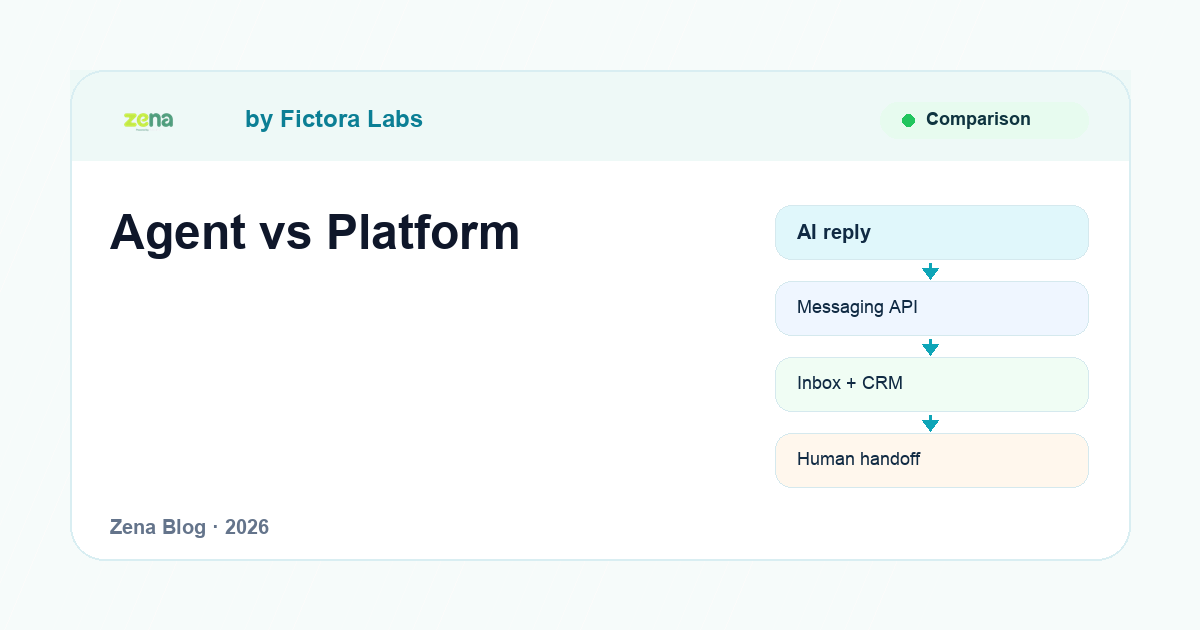
The agent talks. The platform delivers and receives business messages. The business still needs to run the workflow behind the chat.
If you're new to Meta Business Agent, start with our full overview → before diving into the comparison.
the simple model
Think of it this way.
| Layer | What it does | What it does not do by itself |
|---|---|---|
| Meta Business Agent | Answers questions, collects information, recommends products, supports sales and service conversations. | Own your CRM, route every chat, manage team permissions, or guarantee business outcomes. |
| WhatsApp Business Platform | Provides business messaging infrastructure, APIs, templates, webhooks, and scale. | Give your staff a ready-made operating system for customers. |
| Zena | Turns WhatsApp into a shared business workspace with inbox, routing, automation, CRM context, broadcasts, analytics, and handoff. | Replace Meta's infrastructure or guarantee that every AI answer is right. |
One thing the table doesn't capture: Meta Business Agent isn't a WhatsApp-only feature. It runs across WhatsApp, Messenger, and Instagram. This comparison focuses on WhatsApp because that's where most UAE businesses will feel it first, but the MBA layer applies to all three.
what the agent is good at
The agent is good at the first layer of conversation.
It can answer repeat questions, request information, recommend products, qualify leads, and help a customer move forward when the source material is clean.
For a business that gets the same questions all day, that matters.
Opening hours. Stock checks. Appointment questions. Product questions. Basic lead intake. First replies after hours.
Those are good AI jobs.
what the infrastructure layer handles separately
WhatsApp Business Platform handles the infrastructure that neither MBA nor your team should have to think about during a conversation: message templates, delivery confirmation, account verification, webhook events, Cloud API access, and messaging compliance rules.
It runs underneath MBA, not beside it. Turning on MBA does not remove any of these requirements. Templates still need approval. Opt-in still matters for broadcast. Business-initiated messaging rules still apply.
what neither one solves alone
Neither layer automatically fixes business operations.
A customer can get an AI answer and still be lost if nobody follows up.
A webhook can deliver a message and still mean nothing if the CRM is empty.
A template can be approved and still be useless if the wrong audience receives it.
This is where most teams feel the gap.
what businesses still need
- A shared inbox, so conversations do not live on one phone.
- Assignment rules, so every customer has an owner.
- CRM fields, so the team knows who the customer is.
- Handoff rules, so AI stops when a person should step in.
- Consent records, so broadcasts do not become spam.
- Analytics, so managers know where the inbox is leaking.
- Clean source material, so AI does not repeat old prices or wrong policies.
what this means for UAE businesses
Many UAE companies already run sales, support, bookings, and delivery updates through WhatsApp.
That makes the agent useful. It also makes the operations layer more important.
If the AI gives a good first reply but the team has no owner, no follow-up, and no customer record, the business has not solved the problem.
It only replied faster.
UAE businesses running Meta ads on Instagram or Facebook should also note: MBA can handle first replies on those channels too. A lead from an Instagram property ad can receive an AI qualification message within seconds — before the conversation ever moves to WhatsApp.
For how this plays out across specific UAE industries, see the use-cases breakdown →
where Zena fits
The comparison in this post identifies the gap: neither MBA nor WBP owns the work after the first reply.
Someone still has to decide who owns the conversation, whether the lead is in CRM, whether the AI reply was actually correct for this customer, and when a person needs to step in. That is the operations layer.
Zena is built for that layer: shared inbox, assignment rules, CRM fields, handoff, broadcasts, and analytics. It works whether the first reply came from AI or a team member.
Ready to do the preparation work? See the UAE readiness checklist →
faq
Which is better, Meta Business Agent or WhatsApp Business Platform?
That is the wrong question. They are not alternatives. MBA is the AI layer. WBP is the infrastructure layer. You do not choose between them. The question that actually matters is what your team does with the customer after both are running.
Do I need both?
A business using WhatsApp seriously will usually need the platform layer. Whether it uses Meta Business Agent depends on eligibility, use case, and rollout.
Where does Zena sit?
Zena sits around the WhatsApp workflow: shared inbox, routing, CRM context, automation, broadcasts, analytics, and handoff.
Sources and further reading
Connect replies to real operations
Zena helps WhatsApp teams handle the work after the first reply: routing, CRM fields, broadcasts, analytics, and human handoff.
See Zena plans →